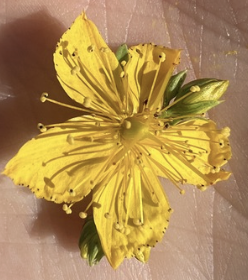
MIND. St. John’s Wort: Friend or Foe?
It’s all about perspective right? There’s a famous cartoon that illustrates that so well:
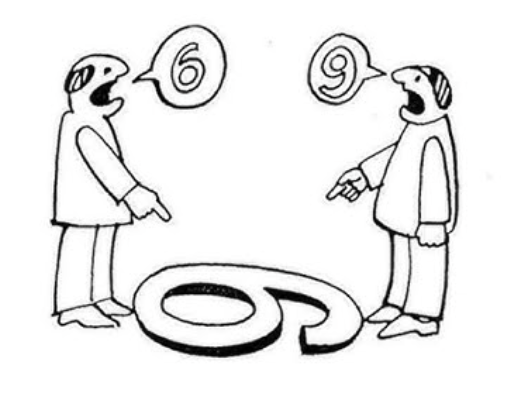
St. John’s Wort is no different. While myself and most herbalists will wax poetic on its many uses, its abundance, and its utility for so many humans, farmers and the USDA have the opposite reaction. One Montana farmer I spoke with last year could not express more strongly his dislike for this noxious weed, and his attempts to eradicate it by using what sounded like an herbicide chemotherapeutic agent (expensive and cost-prohibitive, and questionably specific and effective). I get it - it messes up the mono-cropping system and has the possibility to cause a skin reaction to cows that graze in a field of St. John’s Wort. Andddd… I also think nature does not make mistakes - SJW is here for a reason. It’s just also in our way, the way we want to do things. I usually think this with both weeds in farms and symptoms in humans - the question isn’t: how can I get rid of it? The question is: what is it trying to tell me?
And then there’s the conventional medical paradigm. Read just about anything online and it will scare you to even touch the plant. It’s dangerous (more on that in a moment). And while effective, we should not use it:
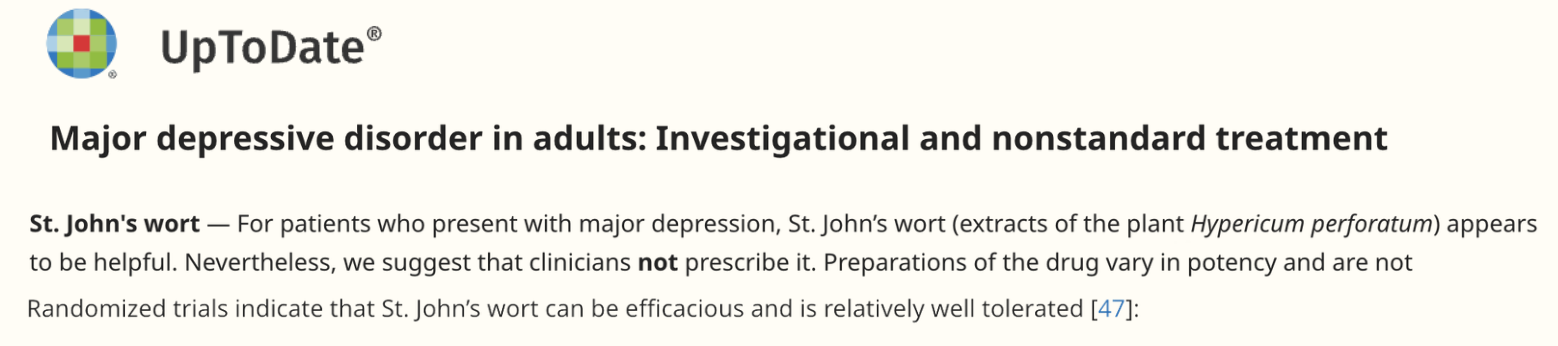
This medical database goes on to cite the trials that go head-to-head with SSRIs (Fluoxetine, Escitalopram, Sertraline, etc) with comparable effects and fewer side effects. Yet the conclusion remains. Herbalist and what often seems like comedian Michael Moore points out:
“...[Hypercium is] Widely used in European medicine, both as OTC and presciption pharmacueticals. It isn’t aggressive enough (or palatable enough) for American drug use. This is another safe plant drug that the FDA says doesn’t work. I guess American patients are geneticaly different from French or German patients.”
It’s true that the main medical constituents studies, hypericin and hyperforin, can vary based on plant. But very often does nature use things in isolation. I am a fan of using smaller amounts of the whole plant vs. pulling out the constituent. As another herbalist says, it’s like taking the oboe out of Beethoven’s Fifth Symphony and giving it all the credit for the music. There’s so much else that accompanies and synergize to make that piece so powerful.
But I’ll stop being philosophical and talk real consequences and contraindications:
Do not take if breastfeeding or in pregnancy
Do not take if on other serotonin enhancing drugs (MOA inhibitors, SSRIs)
possibility of serotonin syndrome, which is an emergent condition
Caution combining with other serotonin enhancing supplements (SAMe, 5HTP)
Do not take with certain medications, as it can decrease their effectiveness (through making your liver work and process more efficiently (I could argue this as a good thing in other circumstances))
In our current medical and “healing” landscape, we are looking for that magic bullet. You may even be looking for me to say, “St. John’s Wort is the herb that you NEED and have been missing!” But I don’t know you. I don’t know what you may need. I think St. John’s Wort is a friend to many, including myself on a daily basis for topical uses (more on that in the BODY article), but requires moderation and knowledge for effective use. Just like most other things, this herb is not a magic bullet. But I do find it both magical and scientific to work with. I wish we had more randomized controlled trial (run by those that use the herb clinically), but for now, most studies are outdated.
I encourage you to at least try to find St. John’s Wort this blooming season to just see what it looks like. Possibly make a new friend. For this plant is all about connection, and by golly, we sure do need more of that these days.