BODY. Comparing Oranges to Oranges.
There’s the old saying, “it’s like comparing apples to oranges,” that highlights fundamental differences between two objects and renders an illogical comparison. Well, I am here to tell you that the world is that much more complex in 2025, and these days we can’t even compare oranges to oranges. Recent data shows they may be so diverse in their nutrient profile to not even render them in the same category.
I studied Nutritional Sciences for my degree and learned all about percent daily values, recommended daily allowances and the chemical structure of vitamin A, D and the entire alphabet soup of how we categorize our food. I will always hold some beef with Cornell University that not once during my expensive degree was the term “Nutrient. Density” used.
A simple observation that you have likely had in your life that not all food is created equal: perhaps a tomato fresh off the vine in Summer is different than the one wrapped in plastic in the store in January. The difference in appearance (redness vs paleness), texture, taste all means that these tomatoes are not in fact the same product and have different nutrient profiles. Yet, look up the nutrition label of a tomato, and nutritional science and labeling says there is no difference.
Regenerative citrus grower, Herb Young of Squeeze Citrus, demonstrates that comparing oranges to oranges is more complex than we may think. As a former scientist in the pesticide industry for forty years, Herb likes to have hard data and results. He set out to see if there was in fact nutritional differences between his retirement project - a regenerative citrus grove in Georgia - and conventional citrus. The data below shows certain citrus may just bring more zest to your life than others:
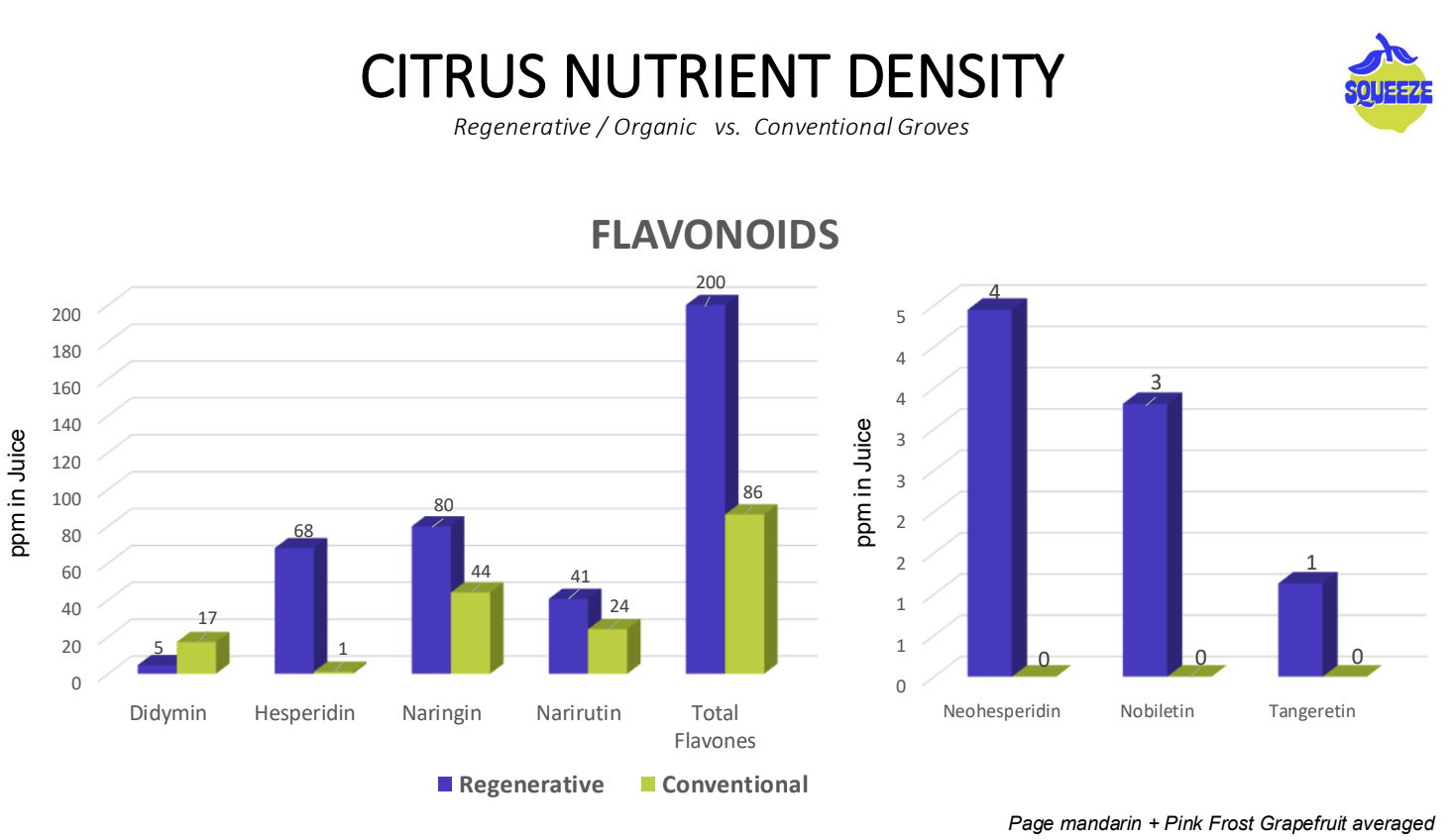
What does this all mean? Citrus grown in different ways does have a large impact on nutrient density - that one grapefruit from Squeeze is equivalent to eight conventionally grown grapefruits. And what are they higher in? Flavonoids, known to have antioxidant properties and potent anti-tumor capabilities. It turns out, we can’t compare apples to oranges, or even oranges to oranges. They likely contain two totally different nutrient profiles.
I see it frequently in nutrient testing I do in patients: low levels of B12, folate, minerals … even if you are eating well with whole foods, if that food has little nutrient value, how medicinal is it?
It is an exciting tipping point in the nutritional sciences world and “food as medicine” movement that we can now measure the varying levels of nutrients in food. And what Squeeze Citrus demonstrates, alongside a mounting movement of regenerative growers that focus on soil health, is that the most diverse of an ecosystem is in the soil, the more nutrient dense the food product.
We need to take the term food as medicine one step further, and trace it back to where health actually begins: in the soil, and on the farm. Those who practice farm as medicine are contributing to reducing chronic disease in illness in a big way. I get excited knowing that these metrics are being measured, talked about and applied in meaningful ways. If we care about food as medicine, we must care about the way in which that medicine is grown. Farm as medicine is a coming trend, and the connections are only becoming more clear.
Want to order some nutrient dense citrus? Squeeze Citrus ships to all states! Check out their website for more information.